
India Market Entry Strategy for a SaaS Company
For India market entry strategy for a SaaS company will have to take depth market research of Indian SaaS market. And it will need a through analysis for the potential rollout of software in the Indian market.
India with 1.4 billion people, a government actively pushing to implement digital india program for everyone. People and businesses of every sizes has increasing need for solutions that help people share and collaborate on files. Considering the present market scenario of the digital economy – any digital product company can create a success story. The report explores different aspects such as market trends, competition, what users prefer, and any rules and regulations to evaluate potential in India.
Globally, the file transfer software market is expanding due to factors such as government regulations, growing demand from various industries. Moreover, security concerns, and the globalization of businesses are other important factors. The need for quick and easy file sharing is driving the demand for file transfer software in across globe and also in India.
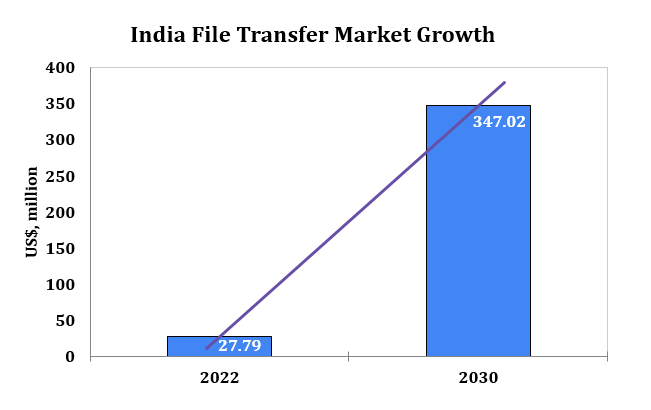
Based on referable data, the Indian file transfer market is estimated to generate a revenue of US$ 347.02 million in 2030 from a market size of US$ 27.79 million in 2022.
The competition in the Indian market for file-sharing and collaboration software is intense. There are numerous local and international players striving to capture market share. New entrant to the market faces significant competition from platforms. Some visible brand are FileTransfer.io, SendGB.com, Ufile.io, Digital Pigeon, Egnyte, ShareFile, raysync, MASV, and Digiboxx.
File Transfer Market Scenario
In recent years, the need for efficient and secure file transfer has become essential for businesses across various sectors. Companies regularly exchange data internally with customers, suppliers, and partners, requiring a reliable file transfer solution across domains. For examples SME of various sizes, professionals, and Individuals who require efficient and secure file-sharing and collaboration tools.
A new market entrant to Indian market would need careful consideration of cultural nuances and preferences. India boasts a multitude of cultures, values, and norms, as well as a plethora of languages. Recognizing and incorporating culturally relevant design elements will also contribute to the acceptance and adoption of the software.
Generally considered approach for any brand to enter a new market is the cost plus mark-up approach. Additionally, brands usually do analysis of benchmarking against competitors, and prevailing market dynamics. By finding the right balance between affordability and perceived value, new entrant company can effectively penetrate the Indian market. Moreover, with a balance marketing tactics new entrant can attract a broad range of customers, from individuals to enterprises. The new entrant can effectively identify to target customer seeking secure and efficient large file transfer services.
India Market Approach
For effectively reaching the target audience in the Indian market, new market entrant should adopt a multi-channel distribution strategy. this may be a combination of online and offline approaches. A multi-channel distribution strategy encompassing local resellers, SaaS marketplaces, system integrators, and direct sales, would be crucial for the success. By leveraging these channels effectively and positioning itself competitively, new market entrant can reach a wider audience, establish strategic partnerships. With a balance channel choice and positioning a new entrant can capture market share in India’s growing large file transfer industry.
To create a success story in a new market a carefully gauged marketing strategy to raise awareness and acquire customers will be important. A well-rounded marketing strategy that combines online and offline channels, leveraging social media platforms, and adapting to local preferences will be crucial to successfully acquire customers in the Indian market. Similarly, a new entrant can effectively utilizing marketing channels to engaging with the target audience. Moreover, it can highlight the unique features and benefits of its services gaining signup prospective customer. Thus, a new entrant can build brand awareness attracting significant customer base in India’s growing large file transfer industry.
Establishing local customer support channels is an important step for customer support and localization effort for market entry. Most importantly it will address India customer primary requirement of face to face meeting. Eventually, establishing a local office speed up contact singing along with addressing data sovereignty and localization concern.
Indian market cultural diversity and opportunity
The Indian market is diverse, with differing regional opportunities, languages, and cultures. It is essential for a new market entrant to carefully factor in to effectively reach and engage the target audience. This includes considering the linguistic and cultural diversity of each Indian state. New market entrant should allocate resources to visit the market, consult with professionals. Moreover, new entrant should engage with prospective partners to understand the market dynamics and build relationships. Understanding Indian consumer preferences, behaviours, product quality acceptance, and buying power is crucial for success.
India’s large file transfer market has tremendous growth prospects. A new market entrant will have an excellent growth potential by carefully weighing in all external factors competition, technology innovation, data protection laws, etc., provided it has control of its internal market influencing factors. It will have good prospect for market entry viability in Indian market.
By addressing the risks and challenges associated with the Indian market entry and capitalising on the market drivers such as large file transfer pain point, ease of uses, pro-file transfers new policy, etc., a new market entrant can position itself for success and tap into the substantial growth potential offered by the Indian market.
Entering the Indian market as a Software as a Service (SaaS) company
Entering the Indian market as a Software as a Service (SaaS) company requires a well-structured strategy due to the country’s diverse and rapidly evolving business environment. First, it’s essential to conduct thorough market research to understand the local demand, competition, and customer preferences. Identifying the key industries that can benefit from your SaaS offerings, such as IT, finance, or education, can help tailor your approach. Localization is crucial, not only in terms of language support but also in adapting your pricing strategies to match the cost-sensitive nature of Indian businesses. Establishing partnerships with local firms can facilitate market penetration by leveraging their existing networks and understanding of the local landscape. Additionally, compliance with India’s regulatory requirements, such as data protection and privacy laws, is vital to ensure smooth operations. Investing in robust customer support and training programs can also enhance user experience, fostering trust and long-term relationships with clients. Finally, an effective digital marketing strategy, utilizing platforms like LinkedIn and local social media, can help build brand awareness and reach potential customers in this vast and dynamic market.
Get your copy of updated India market entry strategy for a SaaS Company